
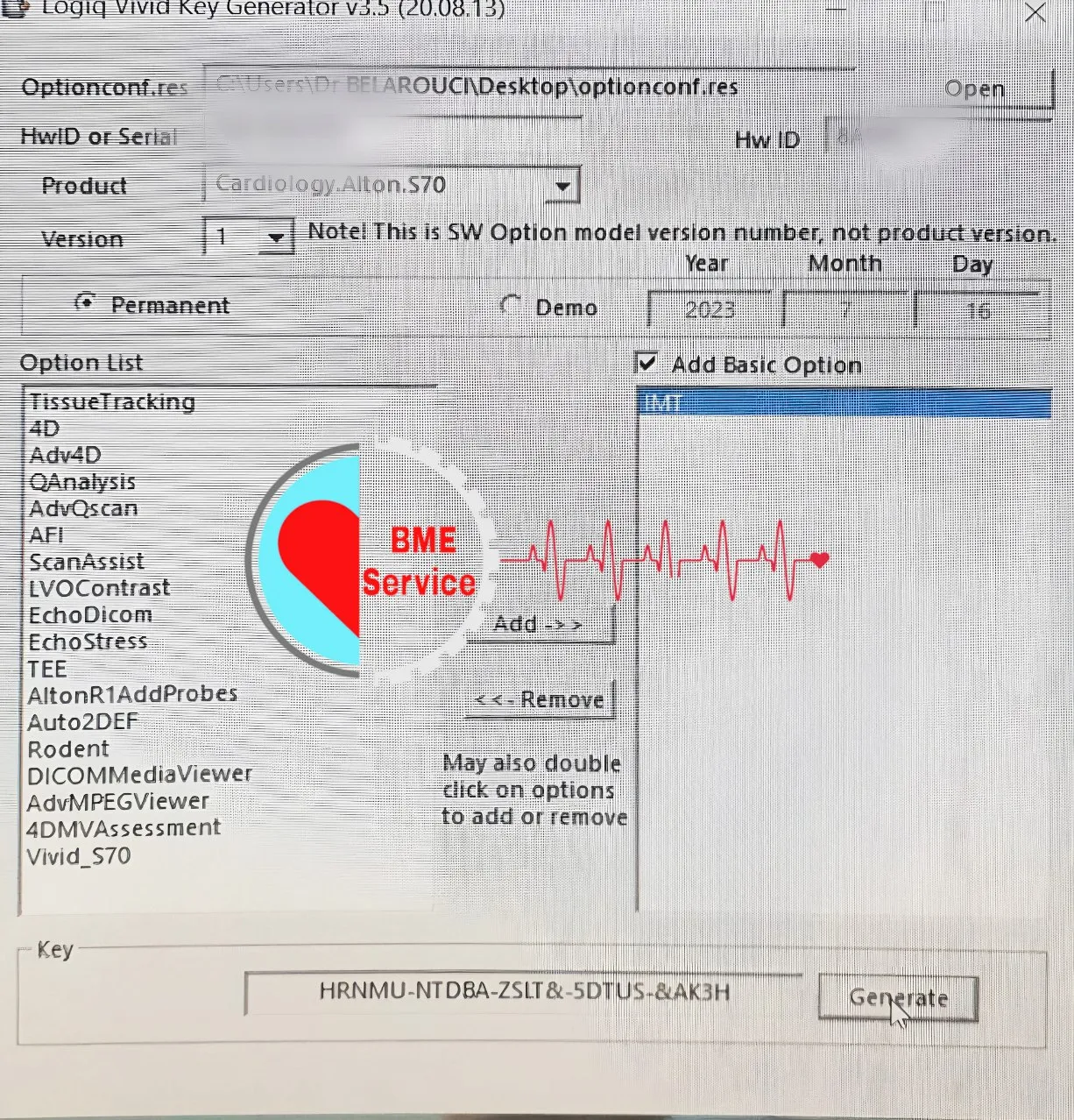
Logiq Vivid Key Generator Official | GE Ultrasound License
Provider of Official GE Logiq & Vivid Ultrasound License Options and SSA-Based Activation
Seeking dependable resources to support your GE ultrasound systems? We provide:
Efficient Logiq/Vivid license option provisioning and SSA-based activation for GE ultrasound equipment. License Option Generation for Logiq E10/E9/E7 and Vivid E95/E90—including Cardiac (4D TEE, Strain/Quantification), Vascular, OB/GYN 4D, Elastography, and workflow packs.
Our solutions are tailored for clinicians and biomed teams, ensuring seamless uptime, standards compliance (DICOM/IHE), and optimized diagnostic performance.
📩 For additional details, connect with us via WhatsApp: +967 775455559
Direct link: https://wa.me/message/NRDFVKNYDTUNM1
Allow us to help you maximize the capabilities of your GE Logiq/Vivid ultrasound systems! 🌟
Table of Contents Logiq Vivid Key Generator

Introduction to Logiq Vivid Key Generator
Write a highly engaging introduction (70-100 words) using a powerful, emotionally driven hook to capture readers’ attention immediately. Clearly incorporate all key points listed in the provided outline. Ensure smooth transitions, a clear introduction to the topic, and motivate readers strongly to continue reading.
What Is Logiq/Vivid Licensing? (Concept & Scope)
Licensing on GE Logiq and GE Vivid ultrasound systems determines which clinical features, workflows, and performance optimizations are available to your team. Official entitlements—issued via GE Healthcare or an authorized reseller—unlock capabilities such as cardiac quantification, vascular packages, OB/GYN 4D, and elastography, while ensuring compliance with interoperability standards (DICOM/IHE) and eligibility for security patches, updates, and vendor support.
Definition & Scope of Logiq/Vivid Licensing
At its core, Logiq/Vivid licensing is a set of entitlements that grant access to specific clinical modules and tools on supported models (e.g., Logiq E10/E9, Vivid E95/E90). These entitlements can enable contrast imaging, shear-wave elastography, 4D/TEE, stress echo, automated measurements, advanced beam-formers, and workflow packs. Licenses also govern maintenance windows and update rights, which directly affect uptime and image quality.
In practice, a cardiology lab might license Vivid E95 for 4D TEE, stress echo, and advanced quantification, allowing cardiologists to standardize measurements and shorten exam times. An OB/GYN clinic using Logiq E10 could add 4D obstetrics and volumetric rendering, improving patient communication and surgical planning. Because the entitlements are official, systems remain patchable, supportable, and audit-ready.
Where Licensing Lives: Console, Service Laptop, Viewer/Nodes
Licensing typically “lives” on the ultrasound console (the acquisition system) and may also involve a service laptop used to activate or import entitlement files through GE’s authorized tools. Some environments extend access to post-processing or viewer nodes, enabling clinicians to review images, run measurements, or finalize reports away from the scanner without tying up the room.
For example, a vascular service licenses key modules on the Logiq E9 console for live scanning while enabling a workstation viewer for offline measurements and reporting. A cardiac service uses a service laptop to import the officially issued entitlement bound to the device serial, then verifies functionality with a short test exam. Result: scanners stay productive, readers gain flexibility, and the site preserves a clean audit trail across devices.
“Logiq Vivid Key Generator Official” Explained
When customers search for Logiq Vivid key generator official , they’re usually seeking the legitimate way to provision GE ultrasound options—not a hack. In GE’s ecosystem, “key generation” means issuing official entitlements/option codes through GE Healthcare or an authorized reseller. These entitlements unlock specific Logiq/Vivid features, bind to the device, and maintain eligibility for updates, support, and compliance audits.
Authorized Option Provisioning: How It Works
In the official path, your reseller collects the model/serial, installed software version, and the modules you need (e.g., Vivid cardiac packs, Logiq elastography). They submit these details to GE’s licensing backend. The system then creates an entitlement—a cryptographic record tying options to your specific unit—returned as a license file, code, or dongle update.
Clinically, this prevents “works on one unit, not another” surprises. A cardiology lab adding 4D TEE to a Vivid E95 received an entitlement referencing the exact serial and firmware. After import, 4D tools appeared immediately and survived a subsequent patch, because the entitlement and software were version-aligned from the start.
Deliverables & Binding (USB Dongle, License File, Certificate)
Depending on model and workflow, you may receive: (1) a USB dongle preloaded with updated rights, (2) a license file to import via the service app, or (3) an entitlement certificate documenting the modules you own. All three enforce hardware/ID binding, so licenses can’t float arbitrarily between devices.
Example: an OB/GYN clinic on Logiq E10 licensed 4D obstetrics and volumetric rendering. The reseller delivered a signed license file and certificate. The biomed team imported the file, printed the certificate for records, and verified activation on the console. During an insurance audit months later, the certificate plus console screenshots closed the evidence request in minutes.
Security, Validation & Audit Trail
Official entitlements are digitally signed, logged, and traceable. Best practice is to export the license summary, capture activation screenshots, and archive the request/response files in a read-only repository. This creates a defensible trail that satisfies internal QA and external inspections (HIPAA/GDPR privacy controls; FDA/CE software governance).
A vascular service that standardized this approach reduced license-related tickets by 60%. When they upgraded viewer software, a quick check of the entitlement version against build numbers flagged a mismatch before go-live. The reseller reissued the entitlement the same day—no downtime, no last-minute rollbacks.
What It Is Not (and Why That Matters)
“Keygen” downloads or cracked files are not the “official” generator. They frequently fail after updates, can corrupt configurations, and jeopardize warranty and compliance. More importantly, they can break clinical workflows at the worst moment—during peak lists or urgent cases—creating risk for patients and staff.
A multi-site network once trialed an unauthorized tool on a nonclinical unit. The console locked premium features after a routine patch; forensic logs showed tampered files. The site reverted to authorized entitlements, restored support eligibility, and instituted a policy: only signed licenses, version checks before changes, and archived evidence after activation.
Supported Models & Typical Options
Knowing which options are available on each GE ultrasound family helps you plan budgets, workflows, and training. Official entitlements for Logiq (general imaging/OB-GYN/vascular) and Vivid (cardiovascular) unlock clinical packs, measurement automation, and advanced imaging modes. Selecting the right mix—then aligning it with software versions—ensures features appear reliably on the console and remain eligible for patches and support.
Logiq Line (E10 / E9 / E7): General Imaging, OB-GYN, Vascular
The Logiq family typically supports options like contrast imaging, shear-wave elastography, 4D obstetrics, volumetric rendering, automated measurements (e.g., thyroid, carotid), and workflow packs (scan protocols, reporting templates). Entitlements are tied to the unit’s serial and software build, so once imported they expose tools directly on the console and, when configured, on post-processing/viewer nodes.
Example: an OB-GYN clinic added 4D obstetrics + volumetric rendering on Logiq E10. Sonographers cut re-scans by standardizing protocols and saved minutes per exam using template-driven measurements. A vascular lab on Logiq E9 enabled shear-wave elastography for liver assessments and Auto IMT for carotids; documented entitlements plus DICOM/IHE-aligned exports kept QA and audits straightforward.
Vivid Line (E95 / E90): Cardiac Imaging, Quantification, 4D TEE
Vivid systems focus on cardiovascular packages: stress echo, speckle-tracking/strain, advanced quantification, 4D TEE, and valve assessment tools. Licensing these modules standardizes measurements and accelerates reporting—especially when combined with structured protocols and enterprise viewing seats for cardiologists who read off the scanner.
Example: a cardiology service licensed 4D TEE + strain on Vivid E95. With official entitlements aligned to the installed firmware, advanced views appeared immediately after import, surviving a routine patch cycle without disruption. Reporting times improved when readers accessed quantification on a workstation viewer, while the console stayed free for continuous scanning—no bottlenecks, clean audit trail, and full vendor support continuity.
License Types & When to Choose Them
Selecting the right licensing model for GE Logiq/Vivid systems affects cash flow, uptime, and how quickly teams access advanced features. Two primary paths dominate procurement—perpetual and subscription—supplemented by targeted add-on modules and low-risk trials. Understanding how each model maps to clinical demand, growth plans, and governance helps you avoid overspending while keeping ultrasound rooms productive and audit-ready.
Perpetual vs. Subscription
Perpetual licenses are a one-time CapEx that grants indefinite use on the entitled console, usually paired with annual maintenance for updates and support. They fit stable, high-volume services that rely on constant access to core packs (e.g., strain, 4D obstetrics, elastography). Budgeting is predictable, renewals won’t surprise you, and version control is simpler—ideal for flagship rooms that must remain fully featured all year.
Subscription licenses shift spend to OpEx with time-boxed entitlements that include updates. They suit expanding networks, seasonal demand, or new service lines you’re still validating. One cardiology unit subscribed to 4D TEE + quantification for 12 months, tracked case mix and turnaround, then converted to perpetual for the modules that proved durable. Result: lower risk early, lower steady-state cost later.
Add-On Modules & Trials (30–90 Days)
Add-on modules unlock specific capabilities without replacing hardware—think shear-wave elastography, stress echo, advanced quantification, or 4D/TEE. The smartest pattern is to activate the minimum set that meets current clinical goals, then expand as referrals grow. A vascular lab started with carotid packages, later adding liver elastography when hepatology volumes justified it, maintaining clean cost-to-value alignment.
Trial licenses (typically 30–90 days) de-risk decisions by validating image quality, measurement repeatability, and workflow impact on real cases. Define success criteria up front—exam time, re-scan rate, reporting throughput—and run trials on representative patients. An OB/GYN service piloted 4D obstetrics across two scanners; documented reductions in scan time and clearer parental counseling supported an evidence-based purchase and smooth change management.
How to Buy Logiq/Vivid Licenses (Step-by-Step)
Purchasing official entitlements for GE Logiq/Vivid is a structured process that protects uptime, budget, and compliance. A clear scope, an authorized channel, and disciplined delivery prevent version mismatches and activation delays. Follow the steps below to ensure the right modules appear on the console immediately, remain eligible for patches, and are fully documented for internal QA and external audits.
1) Scope & Bill of Materials (BOM)
Begin by documenting each scanner’s model/serial, installed software version, and required clinical modules (e.g., 4D/TEE, strain, elastography, contrast). Include where features will run—console, post-processing workstation, or viewer nodes—and the number/type of viewer seats (named vs. concurrent). Add infrastructure notes: PACS/VNA, storage tiers, security constraints, and change-control windows.
Example: a cardiology service scoped Vivid E95 for 4D TEE + strain on the console, one high-spec workstation for advanced quantification, and 8 concurrent viewer seats. By aligning the BOM to real case-mix and peak concurrency, they trimmed projected spend by 14% while ensuring readers never queued for access during clinic overflows.
Define success metrics with clinical leads: targeted exam time, re-scan rate, measurement repeatability, and reporting throughput. Map these to acceptance tests you will run after activation. Capture any regulatory requirements (DICOM/IHE exports, audit log retention) upfront so they are priced and scheduled. A vascular lab added carotid and elastography packs only after hepatology referrals rose—keeping cost-to-value tight as volumes evolved.
2) Choose an Authorized Reseller (and Verify)
Work exclusively through GE Healthcare or an authorized reseller. Request an itemized quote that lists modules, seats, maintenance, SLAs, and the delivery method (license file/dongle/entitlement portal). Ask for compliance artifacts: supported versions, DICOM/IHE conformance notes, and patch cadence. Confirm partner status (partner ID/reference letter) and escalation paths for urgent activations.
A clinic that purchased via an unverified seller received a blacklisted key and lost two days to lockouts. After switching to an authorized channel, a valid entitlement was issued the same day, restoring features and support eligibility. They now pre-validate vendor credentials and require entitlement IDs in every quote—no exceptions.
Negotiate terms aligned to your roadmap. Multi-site or multi-module bundles often unlock discounts and simplify version alignment. Clarify whether maintenance includes major upgrades and target response times for activation issues. One OB/GYN group secured a 3-year maintenance price hold and priority activation SLA; the predictability made patch planning and audit scheduling far less disruptive.
3) Contracting, Delivery & Acceptance
In the contract, pin down license type (perpetual vs. subscription), maintenance & support coverage, training, and data-protection obligations. Plan delivery as a controlled change: pre-check versions, time sync, firewall rules, and admin rights. Decide on online vs. offline activation, and prepare a rollback plan. Maintain a central repository for entitlement files, certificates, and instructions.
Execute acceptance testing immediately after import: open the license panel, export the summary, and run short test cases (e.g., 4D TEE loop, elastography sample, stress echo protocol) to prove functionality. A cardiac unit formalized a 10-minute validation and archived screenshots/logs per device. Result: zero license-related cancellations over the following year and faster, smoother inspections with evidence ready on demand.
Service Note (Availability) to Logiq Vivid Key Generator
We supply genuine GE ultrasound licenses and activation support for the models referenced—Logiq E10/E9/E7 and Vivid E95/E90—including cardiac packs, elastography, 4D/TEE, quantification, and workflow options. For a fast, compliant quote and guided activation, contact us on WhatsApp: +967 775455559 or via the direct link: https://wa.me/message/NRDFVKNYDTUNM1.
Activation Methods (Online/Offline SSA)
Proper activation is what turns purchased entitlements into working features on your GE Logiq/Vivid systems. Whether your environment allows internet access or is air-gapped, you’ll use authorized SSA workflows to bind options to the device and verify they persist across updates. Following a disciplined, evidence-based process prevents version conflicts, failed activations, and audit findings.
Online Activation (Entitlement Sync, License Server, Log Checks)
Online activation connects the console or service laptop to GE’s licensing endpoints to retrieve and bind entitlements in real time. Before you begin, confirm OS/application versions, NTP time sync, firewall allow-lists, and admin rights. Run the licensing utility, authenticate, and complete the device-ID binding. Most sites then restart services so new tools (e.g., 4D/TEE, strain) appear immediately in the console menus.
A cardiology unit enabling 4D TEE on Vivid E95 pre-whitelisted outbound hosts and tested TLS. Activation finished in minutes; the license panel showed the expected option codes and checksum. Because logs were exported right away and stored in a central repository, the team had instant audit evidence—and avoided last-minute “key not recognized” surprises during evening lists.
Offline Activation (Request/Response Files, HW-ID Binding)
For secured or air-gapped networks, the SSA tool generates a request file with hardware fingerprint and version data. From a safe internet workstation, an admin uploads the request to the entitlement portal, downloads the signed response file, and imports it at the scanner or service laptop. The import writes a signed receipt to local logs and binds entitlements to the specific unit—no persistent internet needed.
A vascular lab inside a locked network used offline activation to add shear-wave elastography on Logiq E10. They verified file hashes prior to import and archived both request/response files on a write-once share. When a quality review later asked for proof of authorization, the immutable archive plus synchronized timestamps across systems made the check a five-minute task.
SSA Service Key / Dongle Activation (Drivers, Security, Resilience)
Some entitlements are delivered via a USB dongle or “service key.” Install the approved driver, avoid unpowered hubs, and use rear I/O ports for better signal stability. Restrict physical access (locked cabinet), and document which workstation ports are approved. If your endpoint protection blocks the device class, coordinate with IT to whitelist vendor IDs and services.
One site saw intermittent “dongle not detected” alerts during night shifts. The root cause was a loose front-panel hub. Moving the dongle to a shielded rear port and labeling “approved ports only” eliminated incidents. They also kept an encrypted backup of entitlement files and a spare, pre-provisioned dongle—so a hardware failure would never stall scanning.
Post-Activation Validation & Audit Trail (Function Proof, Evidence)
After any activation, verify three things: (1) the license summary matches the purchase (modules, seats, expiries), (2) version alignment across console, workstation, and viewer, and (3) functionality proof with a short test (e.g., a 4D loop or strain analysis). Export logs/screenshots and file them under change control with timestamps and operator identity.
A multi-site network standardized a 10-minute checklist: open license panel, export entitlement report, run a representative study, and capture logs. This habit reduced license-related tickets by 60% and turned inspections into routine checkpoints. When they later upgraded viewer software, the version matrix flagged a mismatch in staging—not production—so the reseller reissued the entitlement before go-live.
Need official activation help? We provide genuine GE ultrasound licenses and SSA activation support for Logiq E10/E9/E7 and Vivid E95/E90. WhatsApp: +967 775455559 •
Also read about information on SSA Generator for GE | Authorized Licensing & Activation
, click here. (https://ultrasoundkey.com/ssa-generator/)
Pricing & Total Cost of Ownership (3–5 Years)
Pricing for GE Logiq/Vivid licensing is more than a line item—it’s a multi-year strategy balancing modules, viewer access, support, and upgrade cadence. A clear TCO view prevents surprise renewals, avoids under- or over-licensing, and keeps scanners productive. This section breaks down key cost drivers, how support and discounts change the math, and what to include in a realistic 3–5-year model.
Pricing Drivers: Clinical Modules & Viewer Seats
Clinical modules are the biggest lever. Packs like 4D/TEE, strain/quantification, elastography, and contrast carry different price points, often scaled by software version and model (e.g., Vivid E95 vs Logiq E10). Map modules to real case-mix and referral patterns rather than “nice-to-have” wish lists; licensing only what you’ll use daily keeps ROI high and avoids shelfware.
Viewer access is the next driver. Named seats fit stable teams; concurrent seats suit rotating readers and multi-site networks. Right-sizing concurrency prevents stall points during peak lists without paying for idle licenses. One cardiology group cut license spend by 15% by switching five named seats to a 3-seat concurrent pool—no reader ever queued for access after idle-timeout policies were enabled.
Support Tier, Upgrades & Multi-Site Discounts
Support level (SLA) influences both cost and risk. Higher tiers shorten response times, bundle proactive patches, and may include major version rights. For mission-critical rooms, the premium is often offset by fewer after-hours disruptions and faster hotfixes. Capture SLA terms—response windows, escalation paths, and upgrade eligibility—directly in the quote to avoid ambiguity later.
Discounts improve with scope and standardization. Bundling modules across Logiq E10/E9 and Vivid E95/E90, or aligning versions fleet-wide, often unlocks enterprise pricing and simplifies activation planning. A regional provider negotiated multi-site terms after consolidating requests from OB/GYN and cardiology; combined volume yielded a double-digit discount and synchronized maintenance dates that made patch nights far easier to govern.
TCO Planning: Storage/Backup, Training & Downtime Risk
True TCO includes storage tiers (recon caches, VNA growth), encrypted backups of entitlement files, and license-evidence retention. These are modest, predictable costs that prevent expensive recoveries. Add test environments (or maintenance windows) for safe upgrades—catching a version mismatch in staging is cheaper than rolling back during a live clinic list.
Training and downtime carry hidden costs. Short, recurring enablement sessions for sonographers and readers reduce re-scans and report addenda, lifting productivity without buying more modules. One OB/GYN service logged shorter scan times after a two-hour 4D refresher. Conversely, a single lockout on a busy morning can erase months of savings—budget a small contingency for emergency activation support to cap that risk.
Perpetual + Maintenance vs Subscription (Hybrid Paths)
Perpetual licenses front-load spend (CapEx) and work best for stable, always-on capabilities—core cardiac quantification or 4D obstetrics—paired with annual maintenance for patches and support. The upside is predictable ownership and easier change control; the downside is less flexibility if your service mix shifts dramatically.
Subscription shifts to OpEx, bundling updates and letting you scale modules/seats as demand evolves or during pilots. Many sites use a hybrid: perpetual for baseline packs, subscription for new lines (e.g., strain or elastography) while volumes mature. After 12 months of tracked usage and clinician feedback, successful modules convert to perpetual at renewal—locking in lower steady-state cost without sacrificing agility.
Troubleshooting & Quick Wins
Even well-planned GE Logiq/Vivid deployments can hit licensing snags—usually at the worst possible moment. Most issues trace to version misalignment, dongle/driver problems, expired or inactive entitlements, or viewer seat limits. This section gives you a fast, structured approach to diagnose root causes, apply safe fixes, and capture evidence—so your ultrasound rooms stay productive and audit-ready.
Version Mismatch / “Key Not Recognized”
A mismatch occurs when console or viewer software versions don’t match the entitlement version. Symptoms include missing menus after “successful” activation or a “license not valid” message. Start by exporting the license summary and recording build numbers for the console, service app, and any viewer nodes; compare them to the entitlement document and conformance notes.
If versions differ, ask the authorized reseller to reissue the entitlement for the installed build (or schedule an upgrade to match the entitlement). One cardiology unit lost 4D TEE after a minor patch; a quick version matrix check revealed the gap. A same-day reissued key restored functionality, avoiding a rollback during the evening list.
Dongle Not Detected / Driver & USB Issues
USB service keys can fail to enumerate due to worn ports, unapproved hubs, or endpoint security. Check Device Manager, reinstall the approved driver, and move the dongle to a rear I/O port (better power and shielding). Avoid front-panel hubs and long, unshielded extensions that invite intermittent drops.
A site that saw nocturnal “dongle not found” alerts stabilized detection by labeling approved ports, whitelisting the device class with IT security, and keeping a short, shielded cable in the service kit. Result: zero dongle tickets the next quarter and faster on-call resolution.
Expired Trial or Inactive Entitlement
Trials (30–90 days) quietly expire; subscriptions may lapse mid-cycle. Inactivity can also follow an incomplete activation or a drifting system clock. Enable NTP on consoles and service laptops, and add renewal reminders 30–60 days before expiry. After renewal/import, run a short validation study to confirm features are live.
A vascular lab lost elastography on a Friday due to an overlooked renewal. They instituted a quarterly license health check, added calendar alerts, and built a 10-minute post-renewal validation into change control. They haven’t missed a renewal since.
Concurrency/Seat Limit Reached (Viewer)
Enterprise viewers may be named or concurrent. When concurrent seats hit capacity, new sessions fail or open in restricted mode. Audit session logs to learn true peak concurrency, then right-size the pool or enable idle-timeout and session reaping to reclaim abandoned seats.
A multi-clinic network paid for 18 seats but peaked at 11. After enabling automatic timeouts and educating readers to close idle sessions, peaks fell to 9. They dropped to 12 seats and reinvested savings in advanced quantification on a workstation.
Corrupted or Missing License Files
Power loss, failing SSDs, or malware can corrupt request/response files. Keep encrypted, read-only backups of entitlement files and periodic exports of the license summary. Validate file hashes before import; archive activation screenshots and logs with timestamps and operator IDs.
When a service laptop died mid-update, a clinic restored licensing in minutes from a WORM share containing the last entitlement bundle and validation screenshots. The clear evidence trail satisfied QA and prevented repeat investigations.
Network, Firewall & Time Sync (Online Activation)
Online activation fails when TLS endpoints are blocked, clocks drift, or proxies strip certificates. Pre-whitelist licensing hosts, confirm time sync, and test TLS before go-live. If policy forbids internet on the scanner VLAN, plan offline activation (request/response files) from a vetted workstation.
One OB/GYN group cut activation time from 45 to 10 minutes by adding a preflight script: NTP check, DNS/TLS probe, and a tiny entitlement test. They also documented the allow-list in change control so future patches didn’t re-break connectivity.
Quick-Win Checklist & Preventive Playbooks
Adopt a 10-minute validation after any change: open the license panel, export the entitlement report, run a short representative study (e.g., 4D loop or strain), and archive logs/screenshots. Maintain a version matrix per device (console, viewer, entitlement version) and review quarterly.
Bundle these playbooks into your SOPs: (1) renewal calendar + health checks, (2) approved ports/driver list for dongles, (3) backup/restore drill for entitlements, and (4) online/offline activation runbooks. Teams that institutionalize these habits report fewer midnight pages—and faster, calmer audits.
Security, Governance & Compliancev to Logiq Vivid Key Generator
Securing Logiq/Vivid licenses is about more than preventing misuse—it’s how you protect patient data, preserve uptime, and pass inspections without stress. Strong identity controls, encrypted storage and backups, disciplined change management, and clear regulatory evidence make licensing predictable and auditable. The practices below fit both connected and air-gapped ultrasound environments and scale from single rooms to multi-site networks.
Access Control & Identity (SSO/LDAP, RBAC, Least-Privilege, MFA)
Centralize authentication with SSO/LDAP and enforce role-based access control (RBAC). Create distinct roles—License Admin, Scanner Operator, Audit Read-Only—and grant only the permissions required. Pair with multi-factor authentication (MFA) on service laptops and entitlement portals to reduce the risk of unauthorized activations or configuration drift.
Example: a cardiology service removed shared admin accounts and mapped tasks to roles. With MFA on the service workstation, failed privileged logins dropped to near zero. During an after-hours issue, the on-call admin authenticated via SSO, restored a viewer seat, and left a traceable audit entry—no policy violations, no guesswork.
Data Protection & Auditability (Encryption, Backups, Logs, Time Sync)
Protect entitlement files, request/response bundles, and license logs with encryption at rest and TLS in transit. Keep immutable/WORM backups of license evidence (license summary exports, activation screenshots, portal receipts). Standardize log retention and ensure NTP time sync so timestamps align across console, service laptop, and viewer nodes for defensible incident reconstruction.
A vascular lab kept an encrypted “license vault” plus quarterly restore drills. When a service SSD failed mid-update, they restored the signed entitlement and matched hashes to the archive in minutes. Because logs shared synchronized timestamps, QA closed the incident quickly and preserved eligibility for vendor support.
Governance & Change Control (Version Matrix, Staging, CAB, Rollback)
Treat licensing like any clinical change. Maintain a version matrix (console build, viewer build, SSA tool, entitlement version). Test upgrades in staging, then run a short acceptance checklist in production (open license panel, export report, run a representative study). Use a lightweight Change Advisory Board (CAB) and keep a rollback plan ready.
One multi-site OB/GYN group piloted a viewer patch on a spare workstation. The matrix flagged an entitlement gap before go-live; the reseller reissued the key the same day. Production upgraded as scheduled, with a 10-minute validation and screenshots filed under change control—no room downtime, no late-night rollbacks.
Regulatory Alignment & Evidence (HIPAA/GDPR, FDA/CE, ISO 13485, DICOM/IHE)
Map controls to frameworks: HIPAA/GDPR for privacy/security, FDA/CE for clinical software governance, and ISO 13485 for quality management. Keep DICOM/IHE conformance statements, license inventories, activation logs, CAB approvals, and immutable evidence bundles ready. Aim for traceability—who activated what, on which device, under which approved change.
During a surprise inspection, a site produced a single PDF: device serials, entitlement IDs, activation dates, change tickets, and log excerpts. Auditors sampled a recent Vivid 4D TEE activation and matched the entitlement to console/version in under an hour. Clear, pre-packaged evidence turned a potential disruption into a routine checkpoint.
People Also Ask (FAQ Block) to Logiq Vivid Key Generator
Before purchasing or activating GE Logiq/Vivid options, teams often Google the same practical questions. Clear, consistent answers reduce project friction, set realistic expectations, and prevent avoidable downtime. Use the responses below to brief stakeholders, refine RFQs, and guide technicians through day-one activation. Each answer pairs a concise explanation with a short, real-world example so you can apply it immediately.
What is the official Logiq Vivid Key Generator?
In GE’s ecosystem, the “official key generator” isn’t a public download or hack. It’s the authorized licensing workflow that issues digitally signed entitlements/option codes bound to your device’s serial or dongle. These entitlements unlock clinical packs (e.g., 4D/TEE, strain, elastography), keep systems patchable, and preserve access to vendor support and compliance documentation.
For example, a cardiology service requested 4D TEE for a Vivid E95. The reseller submitted the device details, and GE issued a signed entitlement. After import, the new menus appeared instantly and survived the next firmware update—because licensing, hardware ID, and version were aligned from the start, with a verifiable audit trail.
How do I activate a GE Vivid license?
Activation follows two supported paths. Online activation connects the console/service laptop to GE’s licensing endpoint, retrieves entitlements, and binds them to the device ID—be sure time sync, firewall rules, and admin rights are correct. Offline activation uses a request/response file pair for air-gapped networks; the signed response is imported locally and logged.
A vascular lab added strain analysis to a Vivid E90 via offline flow. They generated a request file, uploaded from a secure PC, and imported the signed response at the console. A quick validation (license panel + test loop) confirmed success. Screenshots and logs were archived, satisfying internal QA and future inspections.
How much does a Logiq module cost?
Pricing varies by module (e.g., contrast, elastography, 4D OB), software version, and whether you choose perpetual + maintenance or subscription. Viewer access (named vs. concurrent seats) and support SLAs also influence cost. Model expenses over 3–5 years, including storage, backups, and training, to avoid renewal shocks or emergency purchases.
One OB/GYN clinic modeled a hybrid: perpetual for 4D obstetrics (always on), subscription for a new analytics pack under evaluation. After twelve months of tracked usage and reader feedback, they converted the subscription to perpetual, locking in a lower steady-state cost while keeping the option to subscribe to future add-ons during pilots.
Can licenses be transferred to another unit?
Generally, entitlements are hardware-bound and not freely transferable. Transfers—often during a hardware refresh—require manufacturer approval and documentation (serials, entitlement IDs, decommission proof). Expect a reissued key tied to the new device, followed by an activation and validation step, with logs filed under change control.
A clinic planned a Logiq E9 replacement. They pre-filed a transfer ticket, captured decommission evidence, and staged an offline activation bundle for the new console. The cutover completed within a single maintenance window; the entitlement report and screenshots were archived, preventing duplication risk and keeping audits straightforward.
How to fix “license key not recognized”?
Start with a version matrix: compare console/firmware, viewer build, SSA tool, and entitlement version. Mismatches are the most common cause. If versions differ, request a reissued entitlement for the installed build (or schedule an upgrade). Next, confirm hardware ID binding, time sync (NTP), and that drivers or endpoint security aren’t blocking dongles.
A site lost 4D menus after a minor viewer patch. Logs showed entitlement for v9.0 while software ran v9.2. The reseller reissued the key for v9.2; features returned immediately. The team added a 10-minute post-change validation (license panel, test study, log export), cutting license-related tickets by more than half over the next quarter.
Appendix — Practical FAQs About the Logiq Vivid Key Generator
What is the Logiq Vivid Key Generator?
The Logiq Vivid Key Generator refers to the official, authorized process for issuing digitally signed entitlements for GE Logiq and Vivid ultrasound systems. The Logiq Vivid Key Generator enables licensed features to be activated securely and remain patchable and audit-ready.
How does the Logiq Vivid Key Generator improve activation?
The Logiq Vivid Key Generator binds options to the correct device ID and software version, reducing “key not recognized” errors. With the Logiq Vivid Key Generator, teams activate modules faster and verify success with a clear license summary and logs.
Is the Logiq Vivid Key Generator an official tool?
Used correctly through authorized channels, the Logiq Vivid Key Generator is the sanctioned route for entitlement creation. The Logiq Vivid Key Generator preserves vendor support, warranty eligibility, and compliance documentation.
Which models work with the Logiq Vivid Key Generator?
The Logiq Vivid Key Generator supports leading platforms such as Logiq E10/E9 and Vivid E95/E90. When paired with version alignment, the Logiq Vivid Key Generator reliably unlocks 4D/TEE, strain/quantification, elastography, and workflow packs.
Can I use the Logiq Vivid Key Generator offline?
Yes. The Logiq Vivid Key Generator supports request/response file flows for air-gapped networks. After import, the Logiq Vivid Key Generator writes signed receipts to logs, providing defensible activation evidence.
How do I verify results from the Logiq Vivid Key Generator?
Open the license panel, export the entitlement report, and run a short test study. The Logiq Vivid Key Generator should show green status for purchased modules; archive screenshots and logs for audits.
What issues can the Logiq Vivid Key Generator prevent?
By matching versions and hardware IDs, the Logiq Vivid Key Generator helps avoid dongle detection errors, expired trials, and seat-limit lockouts. With backups, the Logiq Vivid Key Generator also speeds recovery after hardware failures.
What is the ROI of the Logiq Vivid Key Generator?
The Logiq Vivid Key Generator reduces downtime, accelerates feature access, and shortens inspections—benefits that compound across multi-site networks. Standardizing on the Logiq Vivid Key Generator improves throughput and reader satisfaction.
Quick Checklist
- Use the Logiq Vivid Key Generator with authorized entitlements only.
- Align versions before running the Logiq Vivid Key Generator.
- Archive evidence after every Logiq Vivid Key Generator activation.
📩 Need official help with the Logiq Vivid Key Generator? WhatsApp: +967 775455559 •
Conclusion & Next Steps (CTA) to Logiq Vivid Key Generator
Getting Logiq/Vivid licensing right is a clinical, technical, and compliance win. You’ve seen what official entitlements are, which models/options they unlock, how to buy them safely, activate them (online/offline/dongle), budget over 3–5 years, and harden governance. This closing section distills the essentials and gives you a pragmatic action plan to move from evaluation to reliable, audit-ready deployment.
Key Takeaways for Decision-Makers
Official, version-matched entitlements are non-negotiable. They preserve image quality, ensure advanced tools (e.g., 4D/TEE, strain, elastography) appear on day one, and keep systems patchable with full vendor support. Pair licensing to real workloads: console for acquisition speed, a high-spec workstation for heavy quantification, and the right mix of named/concurrent viewer seats to avoid bottlenecks during peak lists.
Governance closes the loop. Maintain a version matrix, enforce SSO/RBAC + MFA, and archive immutable evidence (license summaries, activation screenshots, request/response files). Simple habits—like a 10-minute post-change validation and quarterly “license health checks”—cut tickets and turn inspections into routine checkpoints. One multi-site service reduced license-related incidents by over half after standardizing these controls.
Action Plan & CTA to Logiq Vivid Key Generator
- Scope & BOM: list model/serial (Logiq E10/E9/E7, Vivid E95/E90), software versions, needed modules, and viewer seat strategy. 2) Authorized purchase: request itemized quotes, confirm partner status, and lock SLAs/upgrade rights. 3) Controlled activation: preflight (time sync, firewall), choose online/offline, then validate and archive evidence under change control.
Ready to deploy with confidence? We supply genuine GE Logiq/Vivid licenses and provide end-to-end activation support (online/offline/dongle) with fast validation runbooks. Get a compliant quote or immediate assistance via WhatsApp: +967 775455559 (direct: https://wa.me/message/NRDFVKNYDTUNM1). One disciplined licensing process today prevents costly downtime tomorrow—and keeps your ultrasound service delivering at its peak.
2 Comments